Formats & quality
How Much Storage Does a Video Take? Size per Minute, 240p to 4K
How many MB is one minute of 720p or 1080p video? See typical sizes per minute, a real measured example, and the simple formula to work out any file size.
By Save Downloads Team Published 7 min read How we write and test
Phone storage disappears fastest to video, so it’s useful to know what a minute of each quality actually costs before you download a season of cooking clips. The honest answer is “it depends on the bitrate”, but the ranges are predictable, and you can check any file yourself with one line of arithmetic.
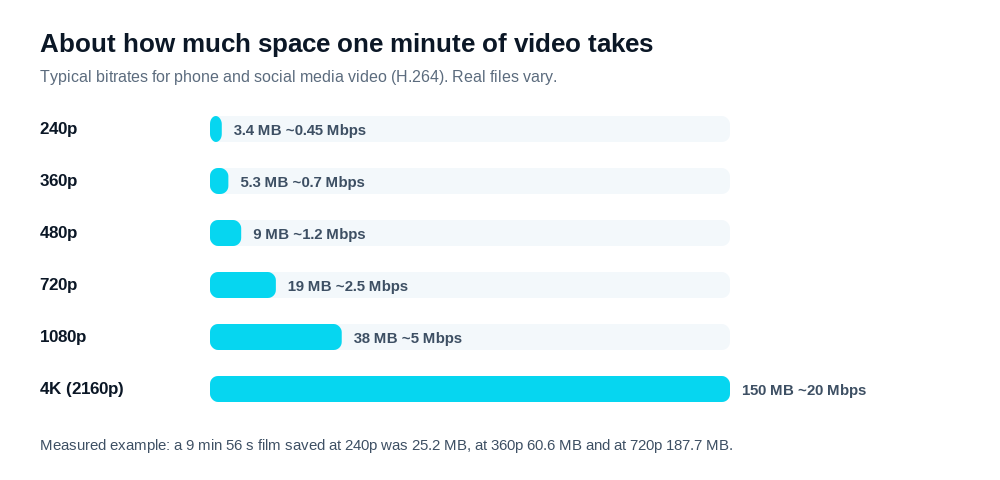
Typical size of one minute of video
These are realistic figures for video as it’s delivered by social media and streaming sites, using the common H.264 codec. They are averages: busy scenes cost more, still scenes less.
| Quality | Typical bitrate | Per minute | 10-minute video | 1 hour |
|---|---|---|---|---|
| 240p | ~0.45 Mbps | ~3.4 MB | ~34 MB | ~200 MB |
| 360p | ~0.7 Mbps | ~5.3 MB | ~53 MB | ~315 MB |
| 480p | ~1.2 Mbps | ~9 MB | ~90 MB | ~540 MB |
| 720p | ~2.5 Mbps | ~19 MB | ~190 MB | ~1.1 GB |
| 1080p | ~5 Mbps | ~38 MB | ~375 MB | ~2.2 GB |
| 4K (2160p) | ~20 Mbps | ~150 MB | ~1.5 GB | ~9 GB |
A real example we measured
Numbers in a table are one thing; here’s a file we actually downloaded while writing this. We used Big Buck Bunny, the open-licence short film by the Blender Foundation, which runs 9 minutes 56 seconds. Save Downloads showed these exact sizes in its quality picker before downloading, on a Redmi 14C:
| Quality offered | File size | Works out to |
|---|---|---|
| 240p | 25.2 MB | ~2.5 MB per minute (~0.34 Mbps) |
| 360p | 60.6 MB | ~6.1 MB per minute (~0.81 Mbps) |
| 720p HD | 187.7 MB | ~18.9 MB per minute (~2.5 Mbps) |
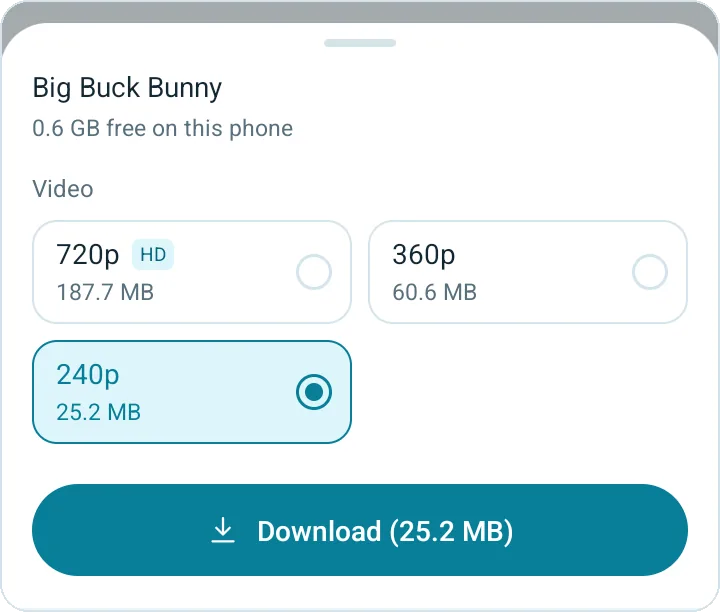
The 720p figure lands right on the typical value in the first table. The 240p copy is smaller than typical because animation with flat colours compresses very well. That’s the general lesson: the type of content changes the size as much as the resolution does.
The formula: work out any size yourself
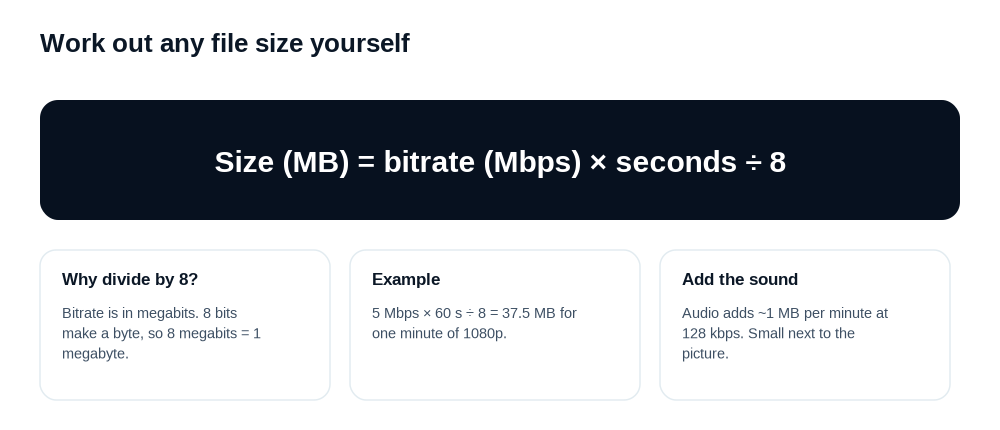
Size in MB = bitrate in Mbps × length in seconds ÷ 8
- A 3-minute (180 s) clip at 5 Mbps: 5 × 180 ÷ 8 = 112.5 MB.
- A 45-minute (2,700 s) lecture at 1.2 Mbps: 1.2 × 2,700 ÷ 8 = 405 MB.
You can also run it backwards to find a file’s bitrate: size in MB × 8 ÷ seconds. Our 720p file: 187.7 × 8 ÷ 596 ≈ 2.52 Mbps.
The sound track adds a little on top. AAC audio at 128 kbps is under 1 MB per minute, so for anything above 360p it barely changes the total. If you’d rather not do the maths, our video size calculator does it for you.
Why your own phone videos are much bigger
If you’ve filmed one minute in 1080p and got a 120 MB file, nothing is wrong. Phone cameras record at high bitrates (often 15 to 20 Mbps for 1080p at 30 fps, and 40 Mbps or more for 4K) because they can’t know how the video will be edited and want to keep detail. When you upload it, the platform re-encodes it to the much lower bitrates in the first table. That’s also why a downloaded copy of your own post is smaller than the file in your camera roll.
Other things that raise the size:
- 60 fps instead of 30: up to about 1.5 times the bitrate for the same quality.
- Lots of motion: sport, concerts, shaky handheld footage, confetti and rain are hard to compress.
- Older codecs: H.264 needs more bits than HEVC (H.265) or AV1 for the same picture. Newer codecs can save 30 to 50 percent, but not every phone plays them smoothly.
Which quality should you pick on a phone?
Screen size matters more than people expect. On a 6.5-inch phone held at a normal distance, most people can’t see much difference between 720p and 1080p, while 1080p costs about twice the space. Our rough guide:
- 720p for most things you’ll watch on the phone itself. Best balance of sharpness and size.
- 1080p for content you’ll cast to a TV, watch on a tablet, or want to keep long term.
- 360p or 480p for lectures, podcasts with video, and anything where the picture barely matters.
- MP3 only for music and talks you’ll just listen to. A 4-minute song at 128 kbps is under 4 MB; see our guide to MP3 bitrates.
A good download app shows the real size of each option before you commit, so you don’t have to guess. If yours doesn’t, the formula above gets you close.
How many videos fit on your phone?
With 10 GB free, you can keep roughly 500 one-minute 720p clips, or about 9 hours of 720p video, or about 4.5 hours at 1080p. If space is tight, see our list of ways to free up storage without deleting photos.
Summary
One minute of typical online video is about 19 MB at 720p and 38 MB at 1080p, and 4K is about four times 1080p. Size depends on bitrate, so the same resolution can vary widely. To work out any file, multiply bitrate (Mbps) by seconds and divide by 8.
Sources and further reading
Frequently asked questions
How many MB is a 1-minute 1080p video?
Typically 30 to 45 MB for a social media or streaming copy at about 4 to 6 Mbps. A 1080p clip straight from a phone camera is bigger, often 100 to 130 MB per minute, because cameras record at a much higher bitrate.
How much space does 720p save compared with 1080p?
Roughly half. A typical 720p copy uses about 2.5 Mbps against about 5 Mbps for 1080p, so one minute is around 19 MB instead of 38 MB.
Why are two 1080p videos of the same length different sizes?
Resolution only sets the number of pixels. The bitrate, codec, frame rate and how much movement is in the scene decide the size. A talking head compresses far better than a football match.
How do I calculate a video's file size?
Multiply the bitrate in megabits per second by the length in seconds and divide by 8. For example, 2.5 Mbps for 600 seconds is 2.5 × 600 ÷ 8 = 187.5 MB.
Save videos, photos and audio on Android
Save Downloads is free, needs no account, and shows the real file size before every download.
Free · v1.0.3.1 · 97.9 MB · Android 7.0 or newer · How to install